
How EDM Tap Remover
Works
Why Tapping on Your Machine Is Costing You Time
Tapping on a CNC or conventional machine might seem convenient — but in reality, it’s one of the most inefficient ways to run your operation.
Your machines are designed for precision machining and complex operations, not repetitive tapping cycles. Every minute spent tapping is time your machine is not doing higher-value work.
Even worse, machines cannot feel what’s happening inside the hole.
When a tap breaks:
- The machine must be stopped immediately
- The broken tap needs to be removed
- In many cases, the part must be taken off the machine
- If the tap is successfully removed, the part must be realigned and set up again
All of this adds downtime, interrupts workflow, and introduces risk.
In the worst cases, the part cannot be recovered and is scrapped entirely.
For a simple operation like tapping, this is a costly and unnecessary use of your machining capacity.
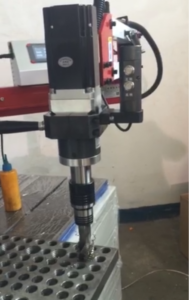
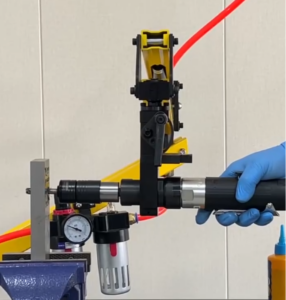
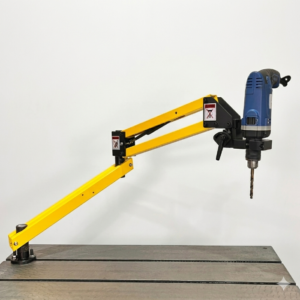
A dedicated tapping arm removes this burden completely — freeing up your machines to do what they are meant to do.
Why Use a Dedicated Tapping Arm?
A dedicated tapping arm transforms tapping from a machine-dependent task into a fast, flexible, operator-friendly process.
- Convenience & Flexibility
Bring the tool to the part. Whether your component is large, awkward, or already off the machine, the tapping arm makes the operation simple and accessible. - Operated by Semi-Skilled Personnel
You don’t need a highly trained machinist for tapping. A tapping arm allows a semi-skilled operator to perform consistent, accurate tapping with minimal training. - Feel & Control
Unlike CNC or rigid setups, a tapping arm gives the operator direct feedback. You can feel resistance changes, misalignment, or tool wear — often before a tap breaks. - Fast Setup
No coordinates. No probing. No programming.
Just position the part under the arm, align visually, and start tapping. - Speed
A pneumatic or electric tapping arm is as fast as — and often faster than — a CNC or conventional machine, without tying up valuable machine time.
Why Adding a Second Process Actually Saves You Money
At first glance, adding a separate tapping operation might seem counterproductive.
In reality, it’s one of the most effective ways to increase throughput and reduce costs.
Your CNC or conventional machine should be doing high-value work — profiling, milling, turning, and precision operations — not repetitive tapping.
By moving tapping off the machine:
- Free Up Machine Time
Your CNC runs longer on complex operations instead of stopping for simple tapping cycles. - Increase Throughput
Parts can be machined on one station while tapping happens simultaneously on another. - Reduce Downtime
No more machine stoppages due to broken taps or tapping issues. - Lower Scrap Risk
Better control and “feel” reduce the chance of tap breakage and damaged parts. - Simplify Workflow
Tapping becomes a quick secondary process instead of interrupting your main machining cycle. - Faster Turnaround
Minimal setup means parts move quickly from machining to finished product. - Better Resource Allocation
Skilled machinists stay on critical machines, while tapping is handled separately.
Why Taps Break
Tap breakage is not unusual — it’s part of real-world machining. Even with good tooling and proper processes, there are several factors that lead to failure:
Cutting Edge Wear
Taps don’t stay sharp forever. As the cutting edges wear:
- Cutting forces increase
- Heat builds up
- Chips don’t evacuate properly
This puts extra load on the tap until it eventually fails.
Built-Up Stress in the Tap
During tapping, the tool is under torsional stress.
If resistance increases — even slightly — that stress rises quickly.
Common causes:
- Tight threads
- Material hardness variations
- Misalignment
Once the stress exceeds the tap’s strength, it snaps.
Chips and Debris in the Hole
Poor chip evacuation is one of the biggest causes of breakage.
- Chips pack inside the hole
- The tap binds or jams
- Torque spikes instantly
This is especially common in blind holes where chips have nowhere to go.
Insufficient Lubrication
Without proper lubrication:
- Friction increases
- Heat builds up
- Material starts to gall
This creates resistance and dramatically increases the chance of breakage.
Incorrect Speed and Feed
Tapping requires the correct relationship between speed and pitch.
- Too fast → excessive heat and wear
- Too slow → poor cutting action and chip formation
- Incorrect feed → axial stress on the tap
Any mismatch can overload the tool.
Misalignment
If the tap is not perfectly aligned with the hole:
- Side loading occurs
- Threads are cut unevenly
- Stress concentrates on one side of the tap
This often leads to sudden failure.
Material and Application Factors
Some materials are simply harder to tap:
- Stainless steel (work hardening)
- Tough alloys
- Inconsistent material quality
These increase cutting forces and reduce tool life.
The Reality: Taps Break — Be Prepared
No matter the brand, coating, or best practices — taps do not last forever.
They have a lifespan.
They wear out.
And eventually, they break.
This is not a failure of process — it’s the reality of machining.
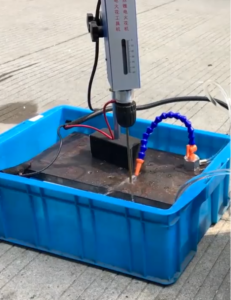
That’s why we also offer EDM tap removers.
These machines use spark erosion to:
- Remove broken taps safely
- Protect the original thread and part
- Eliminate the need for drilling or damaging extraction methods
Because in the real world, taps break — and when they do, you need a reliable way to recover your parts without losses.
The Bottom Line!
Investing in a dedicated tapping arm — and having a solution for broken taps — is not adding complexity.
It’s removing inefficiency, reducing risk, and keeping your production moving.